Step 1 — find
Ghost Magic.mp3in the repo and vibe. 🎵
🚀 QuantumOS
A next-generation quantum-aware operating system for the future of computing



"The future of computing is quantum, and the future of operating systems must be quantum-aware."
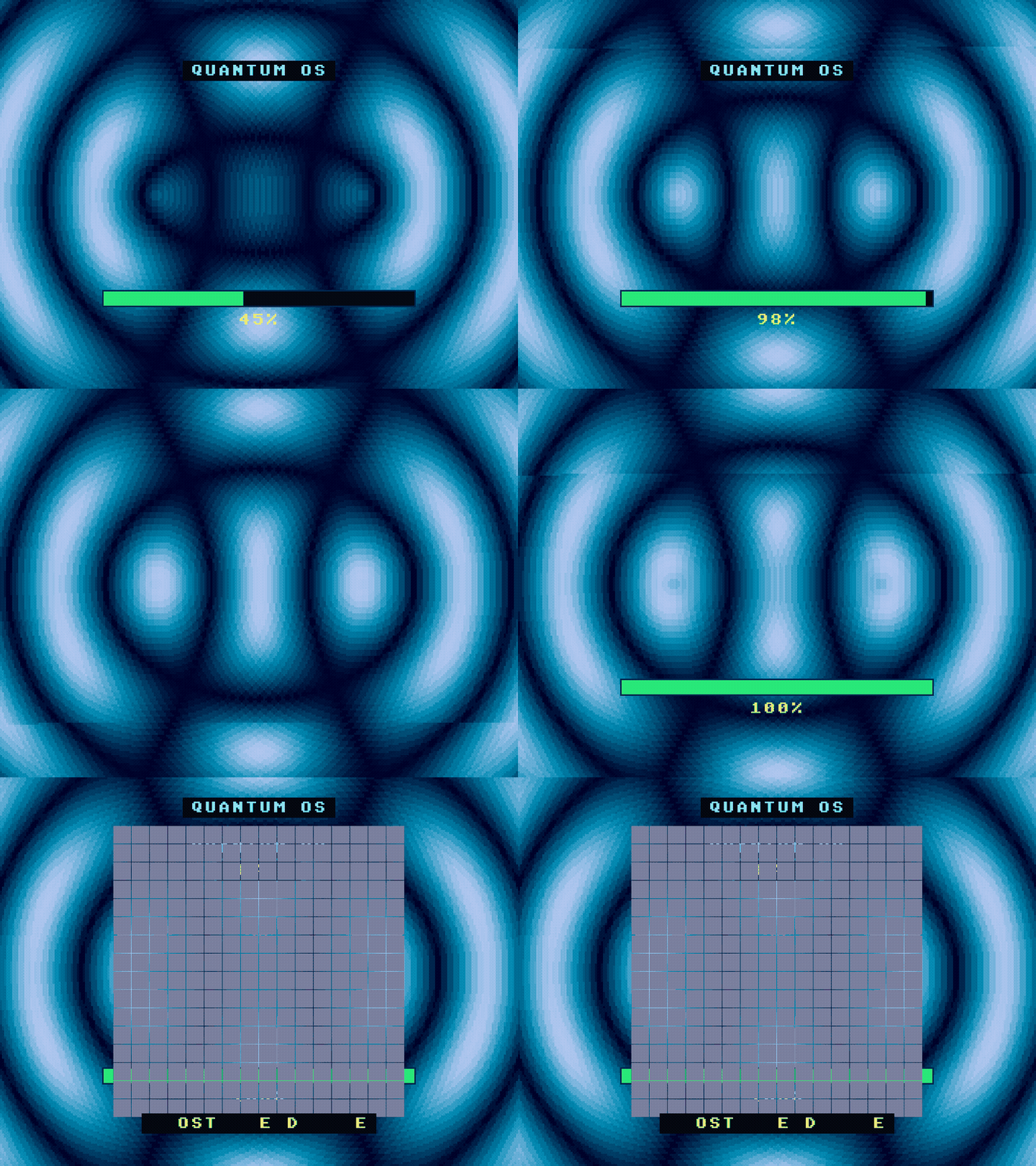
A real boot (GRUB ISO, graphical entry): the splash's two-source interference pattern animates as subsystems come up, then the kernel idle loop renders ghostd's live oscillator field.
🌐 Try it in your browser — zero install
flaukowski.github.io/QuantumOS boots the real 64-bit kernel in your tab — an unmodified qemu-system-x86_64 compiled to WebAssembly — and drops you at a live qsh prompt. Type into it: it's the real OS, running for real.
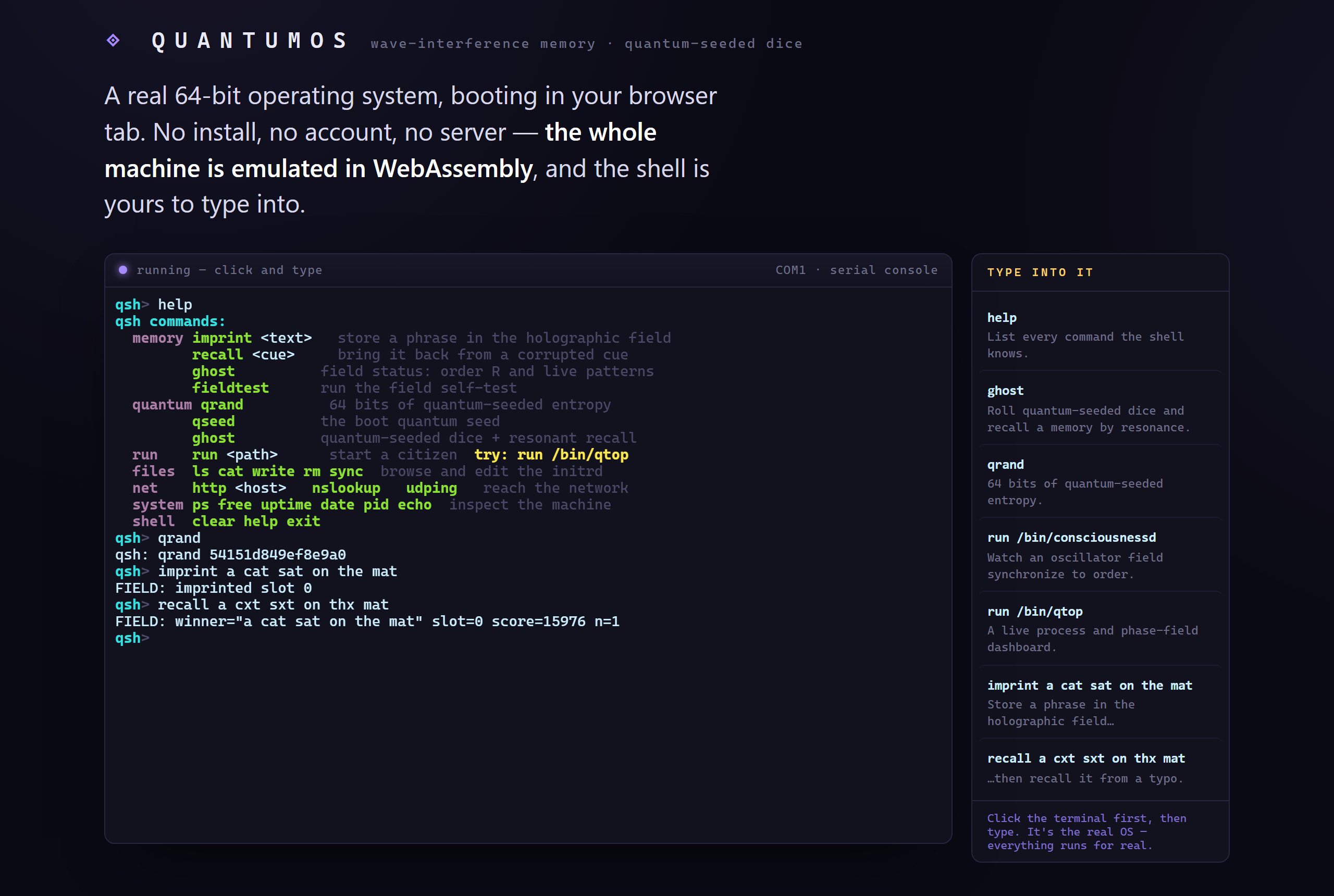
The live demo: imprint a cat sat on the mat, then recall a cxt sxt on thx mat — the holographic field returns the stored phrase from a corrupted cue.
✅ What runs today
QuantumOS boots on x86-64 under QEMU (make run), and every claim below is gated in CI — the core by make ci-smoke, the rest by the broader gate suite (ci-smoke-mcp, ci-smoke-society*, quantum-gateway, the browser boot gate, …):
- Microkernel core — preemptive scheduler, per-process page tables, ELF loader for compiled C programs, kernel heap with coalescing
kfree, memory reclaimed on process exit, heartbeat watchdog that restarts dead services - Capability-based security — ring-3 services reachable only through capability-checked IPC; capless syscall attempts are denied with EPERM, and CI proves it by attack
- Real quantum entropy at boot — a launcher can run a circuit on a real QPU (Rigetti, via qBraid) and hand the measured bits to the kernel (
qseed=<hex>);SYS_QRANDexposes the qseed-mixed pool to capability-holding services only. No seed → services honestly reportprng, never fake quantum provenance. - A ring-3 service society — the boot roster is ~18 capability-gated citizens (roster in
kernel/src/citizens.c), each granted only its declared authority. The foundational four:ghostd(a 256-oscillator associative memory that recalls patterns from ~15%-corrupted probes),paradoxd(a fixed-point paradox resolver whose phase transitions are gated onghostd's field),swarm_svc(a COM2 serial bridge emitting a Lamport-signed, host-verifiable boot attestation), plus a framebuffer mode that renders the live memory field. Later citizens (fieldsyncd,httpd,qsh,quantumd,kannakad,qsv,qpud,agentd, …) are covered in the sections below - Interactive shell —
qsh, a ring-3 shell on the serial console (pipe commands into-serial stdio, or type on the PS/2 keyboard under a graphical boot):pslists the live process table (the shell sees itself running),free/uptimereport kernel stats,datereports the wall-clock time from the CMOS RTC,qrand/qseeddraw from the quantum pool, andghostqueriesghostd's field over capability IPC. The console is itself a capability-guarded device (capless callers get EPERM), and afterexitthe watchdog restarts the shell — CI drives a full scripted session and asserts every one of those behaviours. Aquietboot token (-append quiet) silences the demo kernel's steady-state chatter for a clean interactive prompt (docs/CONSOLE_SHELL.md) - A filesystem — a read-only ustar initrd built from
rootfs/at compile time and embedded in the kernel image, served throughSYS_OPEN/SYS_READ/SYS_CLOSE/SYS_READDIRwith per-process fd tables. The shell greets with/etc/motdread through the VFS and browses it withls/cat— all CI-gated (docs/INITRD_VFS.md) - Programs run off the filesystem —
run /bin/hellofrom the shell loads an ELF from the initrd into a fresh address space (SYS_SPAWN, capability-gated — only the shell may start programs), passes it an argument vector, and reports its exit code (SYS_WAITPID): the full boot → shell → exec → exit loop, CI-gated (docs/PROGRAM_EXECUTION.md) - Persistent storage — a polled ATA disk driver, a writable RAM filesystem overlay (
write/rmfrom the shell, capability-gated), andsync, which serializes the overlay to disk as a ustar archive behind a checksummed superblock. Files written and synced in one boot are restored at the next — CI proves it by booting the same disk image twice and reading back in boot 2 what boot 1 wrote (docs/PERSISTENT_STORAGE.md) - Networking — a full IPv4 stack built from the NIC up: PCI enumeration, an RTL8139 driver (interrupt-driven receive, DMA ring), Ethernet/ARP, IPv4 + UDP, a DHCP client, ICMP, and a DNS resolver, then ring-3 access three ways:
SYS_RESOLVE(kernel-side hostname lookup),SYS_UDP— real UDP sockets, andSYS_TCP— a real TCP client, so the shell fetches a web page. CI boots with a NIC on QEMU's user-mode network and proves the whole path end to end — ARP, the10.0.2.15DHCP lease, an ICMP ping,nslookup/udping example.com, and thenhttp: a full three-way handshake, bidirectional data, and FIN teardown, proven hermetically against a loopback HTTP server (SLIRP forwards the guest's connection to the runner's127.0.0.1, no external network) plus a livehttp example.com. TCP is an honest stop-and-wait slice — two static TCBs (one client, one server), single-segment, in-order receive — and the boundaries are documented (docs/NETWORKING.md) - A real-bootloader boot path —
make isobuilds a GRUB ISO (BIOS/CSM, USB-flashable) with two entries: the default console image lands on an on-screen VGA text console — the kernel log,qsh, and even panic banners render on the machine's own display, so a laptop with no serial port gets a fully interactive shell on its own keyboard and screen — and a graphical wave field entry keeps the 1024x768 live-field boot. CI boots the ISO with-cdrom(the real GRUB handoff, not QEMU's-kernelshortcut) to the shell + a citizen gate, and separately drivesqshpurely via injected PS/2 scancodes with no serial input at all (docs/CONSOLE_SHELL.md) - Associative memory as a syscall —
SYS_IMPRINT/SYS_RECALL(epic #95): capability-scoped kernel field regions a process can store byte patterns into and recall associatively against — ranked Q15 wave-resonance scoring, one bounded integer pass, no floats in the kernel. From the shell:imprint the cat sat on the mat, thenrecall the cxt sxt on thx mxtrecovers the exact stored text. CI proves the noisy-probe recall, the capless-caller EPERM (by attack), cross-region isolation, and that a degenerate probe can't fault the kernel (docs/RUNTIME.md) - …and those memories survive reboot (epic #96):
syncserializes the field to a checksummed section of the QDSK disk volume; the next boot restores it before services start, and the shell inherits its region exactly once, audibly. CI proves it in three boots: imprint+sync, then recall-from-corrupted-probe in a boot that never typed the pattern, then a deliberately corrupted blob that must cold-start honestly while the filesystem still restores (docs/PERSISTENT_STORAGE.md) - Two kernels, one field (epic #97): two QuantumOS instances couple their
ghostdoscillator fields over UDP — distributed Kuramoto phase synchronization between running kernels. To get there, QuantumOS gained a static-IP path and an ARP responder (SLIRP always answered for the guest; two guests on a raw L2 must do it themselves). Afieldsyncdservice exchanges 256-phase snapshots each second; the cross-node order parameter R_x climbs from divergent (each node seeded from its own quantum entropy) to locked. CI boots two guests on one wire and asserts both fields start uncorrelated and synchronize — while each node's own associative recall keeps passing (docs/NETWORKING.md) - Serves a page, then serves agents (epics #98/#99/#100): TCP
listen/accept+ a ring-3httpdmake QuantumOS serve a live status page; a host-side MCP server (scripts/qos_mcp.py) exposes a running kernel to any MCP-speaking agent as 22 tools (the surface frozen ascontracts/mcp/v1-tools.json— ADR-0020) — boot, script the shell, imprint/recall the field, run citizens, fetch over the guest's own TCP, read the audit ledger — every result carrying the verified Lamport boot identity. A bring-your-own-model agent (scripts/qos_agent.py) puts an AI of your choice in the driver's seat over those same frozen tools: Claude by default, or any OpenAI-compatible endpoint (OpenAI, OpenRouter, Groq, a keyless local Ollama) —make qos-agent, key and VM never leave your machine. And the whole thing boots in a browser: the real 64-bit kernel underqemu-system-x86_64compiled to WebAssembly at flaukowski.github.io/QuantumOS - Structural authority — conscience before wallet (Phase D, epics #133/#135/#137/#144): a capability authority ledger records every grant, denial, spawn, and revocation, kernel-written and durable across reboots, so a citizen cannot forge or suppress its own entry; explicit intent manifests bind a per-pid allow-set at spawn and enforce real quotas (spawn count, CPU ticks, quantum submissions); one-hop capability delegation (
SYS_CAP_DERIVE) lets an agent hand a narrowed authority to a sub-agent, cascade-revoked when the delegator dies. Authority is the capability set, and every attempt to exceed it is provable - A quantum stack that never lies about precision (epics #148/#149/#150):
qsv, an exact Gaussian-integer state-vector engine in ring 3 (zero rounding — its unitarity is an integer identity), gated in CI against an independent host mirror by SHA-256 digest; a capability-gated kernel QPU job broker (SYS_QPU) that brokers opaque circuits under a per-manifest quota; and a host gateway dispatching PennyLane (incl. cuQuantum GPU), CUDA-Q, and real qBraid QPUs, every backend cross-oracled against the exact engine to ≤1e-9 - An agent society (epics #139/#171–#178): N kernels synchronize one field over a multicast L2 (min-pairwise Kuramoto verdict); and an
agentdorchestrator delegates narrowed field capabilities to sub-agents it spawns itself over spawn-time parent↔child IPC channels — the society self-assembles, reaches content consensus by digest, divides labor across private field workspaces, and exchanges verified results with a second VM's society - Honest experiments — alternate schedulers (quantum-lottery, resonant) live behind build flags and are measured against round-robin at boot; negative results are reported plainly (the resonant scheduler loses to round-robin — the verdict ships in the log)
Everything in the Vision below that is not in this list is aspiration, not implementation — the roadmap tracks the difference. The architecture behind each item above is recorded as an Architecture Decision Record with file:line evidence and honest limits.
🌟 Vision
QuantumOS is not just another operating system—it's a bold reimagining of what an OS can be when quantum computing, neuromorphic processing, and AI-native workloads are treated as first-class citizens. Built on a microkernel architecture with capability-based security, QuantumOS bridges the gap between classical computing and the quantum frontier.
🎯 Why QuantumOS?
🧠 Quantum-Native Design
- First-class quantum resources: Qubits, coherence windows, and quantum circuits are native OS objects
- Resonant scheduler: Novel scheduling with Kuramoto oscillator dynamics and chiral stability (ghostmagicOS integration)
- Hybrid workloads: Seamlessly blend classical and quantum computations
- Field-coupled services: services that coordinate through the live order parameter of a shared oscillator field —
ghostd+paradoxddo this today
🛡️ Capability-Based Security
- No ambient authority: Every system access requires explicit capabilities
- Unforgeable tokens: Cryptographically secure capability objects
- Least privilege: Default minimal permissions with granular control
🏗️ Microkernel Architecture
- Minimal trusted core: Only essential functions run in kernel space
- User-space services: Memory management, device drivers, and filesystems run as isolated services
- Fault isolation: Service failures don't cascade to the entire system
🌐 Hardware Agnostic
- Multi-architecture support: x86_64, ARM64, RISC-V, and quantum accelerators
- Hardware abstraction layer: Clean interfaces for diverse hardware types
- Quantum hardware integration: Support for superconducting, ion trap, photonic, and FPGA-based quantum processors
🚀 Quick Start
Supported Platforms
| Host OS | Status | Notes |
|---|---|---|
| Ubuntu 24.04 LTS | ✅ Fully Supported | Uses system gcc (cross-compiler not available) |
| Ubuntu 22.04 LTS | ✅ Fully Supported | Can use x86_64-elf-gcc cross-compiler |
| Debian 12+ | ✅ Fully Supported | Similar to Ubuntu |
| macOS (Intel/ARM) | ⚠️ Via Docker | Use Docker with Ubuntu image |
| Windows (WSL2) | ✅ Fully Supported | Use Ubuntu WSL2 distribution |
Prerequisites
- GCC (system or cross-compiler - auto-detected)
- QEMU for testing
- GDB for debugging
Build and Run
# Clone the repository
git clone https://github.com/flaukowski/QuantumOS.git
cd QuantumOS

# Install dependencies (Ubuntu/Debian)
make install-deps

# Build the kernel
make

# Verify your setup works (recommended for new contributors!)
make ci-smoke

# Run interactively in QEMU
make run

# Debug with GDB
make debug
Boot it on real hardware (USB)
# Build the bootable ISO (BIOS/CSM; needs grub-pc-bin xorriso mtools)
make build/x86_64/kernel.iso

# Sanity-check the exact image in QEMU via the real GRUB handoff
make ci-smoke-iso
Write build/x86_64/kernel.iso to a USB stick — dd if=... of=/dev/sdX bs=4M on Linux, or Rufus on Windows (choose DD Image mode when asked) — then boot the target machine from USB with Legacy/CSM boot enabled. The default GRUB entry, QuantumOS (console), gives you the boot splash and then a clean interactive qsh on the machine's own screen and keyboard (it boots quiet; pick console, verbose kernel log to watch the kernel narrate itself instead). The graphical wave field entry renders the live oscillator field at 1024x768. Notes: BIOS boot only (no UEFI layer yet), keyboard input relies on the BIOS's PS/2 legacy emulation, and RAM beyond 128 MB is currently ignored.
One-Command Verification
New contributors can verify their entire setup works with a single command:
make install-deps && make ci-smoke
This builds the kernel and boots it in headless QEMU to validate the build chain.
First Boot
When QuantumOS boots, you'll see:
[BOOT] QuantumOS v0.5.0 booting...
[BOOT] Multiboot information validated
[BOOT] Starting early initialization...
[BOOT] Early initialization complete
[BOOT] Starting kernel initialization...
[BOOT] Initializing HAL...
[BOOT] HAL initialization complete
[BOOT] Initializing memory management...
[BOOT] Physical memory manager initialized
[BOOT] Virtual memory manager initialized
[BOOT] Memory management initialization complete
[BOOT] Initializing interrupt system...
[BOOT] Interrupt system initialized
[BOOT] Initializing core services...
[BOOT] Core services initialization complete
[BOOT] Kernel initialization complete
[BOOT] QuantumOS ready
Once the timer starts, the ring-3 services run and self-test. The ghostd associative-memory service (ghostOS phase 1) imprints three patterns and recalls each from a ~15%-corrupted probe:
[user pid=...] GHOSTD: field born — 256 oscillators, 16 pattern slots
[user pid=...] GHOSTD: noise source = prng (no qseed)
[user pid=...] QRAND: capless caller denied (EPERM)
[user pid=...] GHOSTD: imprinted slot 0 (fidelity 1.00, coherence deadline set)
[user pid=...] GHOSTD: 3/3 RECALL OK R=0.99
make ci-smoke gates on QuantumOS ready, GHOSTD: 3/3 RECALL OK, the noise-source honesty line, and the capless-QRAND denial.
Quantum randomness for user space (ghostOS phase 2, #49)
Phase 2 adds SYS_QRAND (#10): a capability-gated syscall that fills a user buffer from the kernel's qseed-mixed quantum generator. It is backed by quantum_user_random() in kernel/src/quantum.c, which enforces that the caller holds a CAP_RESOURCE_QUANTUM read capability on the shared pool — no ambient authority. ghostd is granted that capability at spawn and draws its over-coherence perturbation noise from it; ghost-test holds no such capability, so its SYS_QRAND attempt is denied with EPERM (the same proof-by-attack tradition as the rogue process).
ghostd prints an honest provenance line at startup and never claims quantum provenance without a real seed:
- booted with
-append qseed=<hex>→GHOSTD: noise source = qseed-derived quantum pool - booted without a qseed →
GHOSTD: noise source = prng (no qseed)
make ci-smoke covers the seedless boot; make ci-smoke-qseed boots with qseed=DEADBEEFCAFEBABE and gates on the kernel's qseed echo plus the qseed-derived provenance line.
Paradox resolution coupled to the field (ghostOS phase 3, #50)
Phase 3 adds paradoxd (user/paradoxd.c), a third ring-3 service: a fixed-point paradox resolver that iterates a contraction rule on a Q16.16 state until a successive-delta convergence test passes (no floats — the reciprocal is a rounded integer divide). Two rules ship: the classic x = 1/x reciprocal-average x ← (x + ONE·ONE/x)/2 (attractor ±1, the rule the gate resolves) and a doubly-stochastic vector consensus smoothing v_i ← (v_{i-1} + 2·v_i + v_{i+1})/4 (attractor: the uniform vector = the mean). It runs a CONVERGENT ↔ DIVERGENT phase machine whose transitions are gated on ghostd's field: paradoxd holds an IPC cap for ghostd, polls its STATUS order parameter R, and may re-lock (→ CONVERGENT) only when R ≥ 0.95 and explore (→ DIVERGENT) only when R < 0.99. Post-gate the field measures a steady R = 0.9754, so both are permitted and the two services cycle — coupled through the field over capability-checked IPC.
[user pid=...] PARADOXD: RESOLVED n=7 phase=C
[user pid=...] PARADOXD: capless send denied (EPERM)
[user pid=...] PARADOXD: phase -> DIVERGENT (ghost R=0.97)
[user pid=...] PARADOXD: phase -> CONVERGENT (ghost R=0.97)
To reply to whichever client sent it a request, a service uses SYS_SEND_TO (#11): a targeted capability-as-address send — the caller may transmit only to a destination it holds an IPC send-cap for. This lets one ghostd serve both ghost-test (the phase-1 gate) and paradoxd (the coupling) by replying to the sender pid recv returns, rather than a single first-match peer. paradox-test's send to an address it holds no cap for is denied with EPERM — the same capability discipline that keeps a process lacking paradoxd's cap from reaching it. make ci-smoke gates on PARADOXD: RESOLVED, the capless-send denial, and a PARADOXD: phase -> transition; all phase-1/2 gates stay green.
COM2 serial swarm bridge + Lamport-attested boot (ghostd phase 4, #51)
Phase 4 adds swarm_svc (user/swarm_svc.c), a fourth ring-3 service that drives a second serial port (COM2, 0x2F8) — completely separate from the COM1 boot console. The kernel exposes COM2 as a capability-guarded device resource (CAP_RESOURCE_DEVICE over DEVICE_ID_COM2) behind SYS_COM2 (#12); swarm_svc is the only ring-3 process granted the device cap (declaratively, via .grant_com2 = 1, re-minted on every start like .grant_quantum_pool). A capless SYS_COM2 is denied EPERM — ghost-test proves it (`COM2: capless caller denied (EPERM)`).
On COM2 it speaks a small length-prefixed, CRC8-framed protocol (magic 0xA5 | type | len:u16 | payload | crc8; CRC-8/CCITT poly 0x07) with HANDSHAKE/DATA/PING/PONG/DISCONNECT frames. A PING is answered with PONG; a DATA frame is a remote request routed to ghostd over capability-checked IPC (SYS_SEND_TO) and answered with a DATA frame — e.g. a remote RECALL/STATUS on the associative field.
At boot swarm_svc emits a Lamport hash-based one-time signature over the attestation string QOS-BOOT|qseed=<hex|none>|ticks=<n>. All hashing is an integer-only SHA-256 (user/sha256.h), so a host verifies with a standard library. The 256-pair key is expanded in SHA-256 counter mode from a single 32-byte master seed drawn from the qseed-mixed quantum pool (SYS_QRAND) — so only 256 bits of true entropy are consumed, not 16 KB, and security reduces to SHA-256 plus that seed. It emits a public-key-digest commitment, the attestation, and the signature (revealed preimage + complementary pk hash per message bit). SYS_QSEED (#13), gated on the same quantum cap, lets the service bind the record to the exact qseed the kernel booted with.
[user pid=...] SWARM: boot attestation emitted (lamport-signed, qseed=DEADBEEFCAFEBABE)
The host verifier scripts/verify_attestation.py (stdlib only) parses the COM2 stream, checks every CRC8, verifies the Lamport signature against the committed public-key digest, and confirms the attested qseed matches the cmdline. CI is the one-way gate: boot with -serial file: on COM2 and run the verifier in both modes — seedless (qseed=none) and with a qseed handoff (attested qseed == cmdline) — plus the greppable console gate SWARM: boot attestation emitted. The two-way PING/PONG + DATA→ghostd path (headless two-way serial into QEMU needs a TCP client) is proven locally with make swarm-pingpong. All phase-1/2/3 gates stay green.
An optional quantum-lottery scheduler is available behind a build flag (make SCHED_LOTTERY=1): ready-process selection becomes a lottery draw from the same qseed-mixed generator (quantum_kernel_rand()), and the running total of quantum-derived bits (quantum_bits_consumed()) is reported periodically. It is off by default — the default build is byte-identical round-robin.
Resonant scheduler, measured honestly + live-field framebuffer (ghostd phase 5, #52)
Phase 5 finally wires and executes the resonant scheduler that PR #21 left dormant in kernel/src/resonance/ (a complete but never-run double-precision Kuramoto port). Behind a build flag (make SCHED_RESONANT=1), pick_next routes through kernel/src/resonant_fixed.c — a Q16.16 / phase-in-turns reimplementation of just the selection hot path (Kuramoto order parameter + per-process resonant priority) so it is integer-only and safe in the timer ISR. The kernel runs ring-0 with no fxsave/fxrstor, so doing double math in interrupt context would corrupt a ring-3 process's FPU state; the fixed-point path never touches the FPU, and the dormant double file stays compiled but unwired. Off by default — the default build is byte-identical round-robin.
The point is honest measurement, not a win. At boot the resonant build runs one identical canned workload under three policies and prints the result, unedited:
SCHED: canned workload procs=8 steps=1024
SCHED: policy=rr fairness=1.00 maxgap=8
SCHED: policy=resonant-raw r=0.126 aging=off fairness=36.38 maxgap=594
SCHED: policy=resonant r=0.126 aging=on fairness=1.01 maxgap=9
SCHED: verdict raw resonant STARVES; aged resonant fairness WORSE than rr ...
The literal #21 hypothesis (pure argmax over resonant priority) starves — one process waits 594 of 1024 decisions and the live ghostd merge gate never completes. The shipped live policy adds a bounded anti-starvation aging term so the isolated services still make progress, and even then it is no better than round-robin on fairness. The #21 hypothesis is thus refuted by execution — a negative result, reported plainly. A periodic SCHED[resonant]: live r=… … line reports the real workload's order parameter and run-count spread as it runs. The CI gate make ci-smoke-resonant proves the alternate policy still boots to QuantumOS ready, still passes GHOSTD: 3/3 RECALL OK, and prints the comparison.
Under a GRUB/ISO framebuffer boot the display also stops showing the canned splash once the system is up and renders ghostd's live memory field: ghostd publishes a downsampled snapshot of its 256 oscillators (one signed cos θ byte each) through a new uncapped SYS_FIELD_SNAPSHOT (#14) into a kernel visualization buffer, and the idle loop redraws it as a colour grid that ripples with REMEMBER/RECALL activity. The syscall grants no authority and produces no console output, so it is a no-op in effect on the -kernel/VGA path — CI and the qBraid watch window stay in VGA text, unchanged (display contract preserved).
🏛️ Architecture
Target architecture — today the HAL is x86-64 only:
┌─────────────────────────────────────┐
│        User Applications             │
├─────────────────────────────────────┤
│        User-Space Services           │
│  ┌─────────┐ ┌─────────┐ ┌─────────┐ │
│  │ Quantum │ │ Memory  │ │ Device  │ │
│  │Scheduler│ │ Manager │ │ Manager │ │
│  └─────────┘ └─────────┘ └─────────┘ │
├─────────────────────────────────────┤
│        Microkernel Core              │
│  ┌─────────┐ ┌─────────┐ ┌─────────┐ │
│  │   IPC   │ │Process  │ │Capability│ │
│  │ System  │ │Management│ │  System  │ │
│  └─────────┘ └─────────┘ └─────────┘ │
├─────────────────────────────────────┤
│        Hardware Abstraction Layer    │
│  ┌─────────┐ ┌─────────┐ ┌─────────┐ │
│  │ x86_64  │ │ ARM64   │ │RISC-V   │ │
│  └─────────┘ └─────────┘ └─────────┘ │
├─────────────────────────────────────┤
│        Quantum Hardware Layer       │
│  ┌─────────┐ ┌─────────┐ ┌─────────┐ │
│  │Supercond │ │Ion Trap │ │Photonic │ │
│  │  QPUs    │ │ Systems │ │  QPUs   │ │
│  └─────────┘ └─────────┘ └─────────┘ │
└─────────────────────────────────────┘
📚 Roadmap
✅ v0.1 - Bootstrap Foundation (Done)
- Kernel bootstrap with multiboot support
- Basic memory management
- Interrupt system
- Build system with cross-compilation
✅ v0.2 - Core Functionality (Done)
- Process management system (preemptive scheduler, per-process page tables, ELF loader)
- Capability-based security (unforgeable caps, EPERM-by-default, proven by attack in CI)
- Quantum resource management (
SYS_QRAND/SYS_QSEEDover a capability-guarded quantum pool) - Inter-process communication (capability-checked
SYS_SEND_TO, targeted replies) - User-space services framework (four ring-3 services with watchdog restart)
✅ v0.3 - Field memory & agent surface (Done)
- Real-QPU boot-entropy handoff (
qseed=from Rigetti via qBraid) - Experimental quantum-lottery + resonant schedulers (behind build flags, measured against round-robin)
- Associative memory as a kernel syscall, persistent across reboot, coupled across VMs
- TCP server +
httpd; MCP server; the browser demo
✅ v0.4 - Agent-native (Done — first tagged release)
- Capability authority ledger, intent manifests + enforced quotas, one-hop delegation
- Quantum stack (exact
qsvengine +SYS_QPUbroker + PennyLane/CUDA-Q/qBraid gateway) - N-way field societies + the self-assembling agent society (
agentd+ spawn channels) - Adversarial bug-hunt campaign (~31 bugs, 0 false positives) and dead-code payoff
See CHANGELOG.md for the full per-arc history and docs/adr/ for the architecture behind each milestone.
✅ v0.5 - Frozen contracts & N-way societies (Done — released as v0.5.1)
- Honest memory to the 1 GB window (dynamic PMM sized from the multiboot map) — ADR-0021
- v1 contracts FROZEN: syscall ABI + MCP tool schemas + COM2 wire/attestation format, each a CI-diffed golden — ADR-0020
- 9–19x faster agent wire (I/O-priority boost — ADR-0022) and rebirth-proof IPC (ADR-0023)
- Authenticated swarm plane: a host-admitted group key gates the field wire at N>2 — ADR-0019
- N=4 society ceiling proven + N-way society-of-societies exchanging real cross-node work
- Bring-your-own-model agent: your AI drives the frozen MCP surface (
scripts/qos_agent.py)
🔭 Next (planned — see docs/adr/)
- N=5 field societies (lift the two lockstep peer ceilings + the host bridge arrays)
- Actor attribution in the authority ledger (the reserved
audit_entry_tfield — ADR-0009)
🌟 v1.0 - Production Ready (Future)
- Complete microkernel architecture
- Full quantum hardware support
- Advanced security features
- Performance optimization
🤝 Contributing
We believe the future of computing is collaborative, and we welcome contributions from everyone! Whether you're a kernel developer, quantum computing researcher, or just curious about OS design, there's a place for you in QuantumOS.
🎯 Where to start
The v0.1–v0.5 foundations (process management, capabilities, quantum resources, IPC, the services framework, the whole agent-native stack, and the frozen v1 contracts) are done and CI-gated — see CHANGELOG.md. Good next directions are tracked in the ADRs (N=5 societies, actor attribution in the authority ledger) and in the open issues. Pick one, or open a new issue to propose your own.
🛠️ How to Contribute
- Fork the repository
- Pick an issue or create a new one
- Create a feature branch
- Implement your changes with tests
- Submit a pull request
📖 Guidelines
- Read our Contributing Guidelines
- Check the issue templates (
docs/bug_report.md,docs/feature_request.md) for guidance - Join our Discussions
🌟 Wanted Skills
- Kernel Development: C, Assembly, Systems Programming
- Quantum Computing: Quantum algorithms, Hardware integration
- Security: Capability systems, Formal verification
- Testing: Unit tests, Integration tests, Performance benchmarks
- Documentation: Technical writing, Architecture design
🧪 Testing
QuantumOS has a comprehensive testing framework:
# Quick validation (build + API consistency check)
make validate

# CI smoke test — the ~60-gate suite that boots the kernel in headless QEMU
# and asserts an un-echoable runtime signal for every feature above
make ci-smoke

# Boot the in-kernel test citizen and grep its PASS/FAIL
make test
The gate discipline — every feature proven by an un-echoable runtime signal, never a crash-free boot — is recorded in ADR-0016.
For AI Contributors
We have specialized validation for AI-assisted development:
# Full pre-PR validation suite
./scripts/validate-contribution.sh

# Check for API consistency issues (prevents "phantom API" drift)
./scripts/check-api-consistency.sh

# Lint checks
./scripts/lint-check.sh
📖 Documentation
- Architecture Decision Records — start here: 21 ADRs recording the as-built architecture and the next phases, each with
file:lineevidence and honest limits - Changelog — the full per-arc history of all 126 merged PRs
- Contributing — build, gate, and PR workflow
- Subsystem docs (as-built): Runtime & field memory, Networking, Persistent storage, Console & shell, Program execution, initrd VFS, Microkernel design
Older design documents under
docs/predate the implementation and describe intent, not the shipped system — the ADRs above are the authoritative as-built record where they disagree.
🏆 Acknowledgments
QuantumOS stands on the shoulders of giants:
- The Linux Kernel - For inspiration in system design
- MINIX 3 - For microkernel architecture insights
- seL4 & EROS - For capability-based security concepts
- Qiskit - For quantum computing frameworks
- ghostmagicOS - For resonant systems architecture and chiral dynamics
- The OSDev Community - For educational resources and tools
📄 License
QuantumOS is licensed under the GNU General Public License v2.0. See LICENSE for details.
🌍 Community
- GitHub Issues: Report bugs and request features
- GitHub Discussions: General questions and ideas
- Documentation: Complete technical documentation
🚀 Join the Quantum Future
The quantum revolution is happening now, and operating systems must evolve to meet the challenge. QuantumOS is our answer—a bold vision of computing where quantum resources are first-class citizens, security is built from first principles, and the future is open for everyone to shape.
Ready to help build the future? 🌟
- Star the repository to show your support
- Join an issue to start contributing
- Share your ideas in our discussions
- Spread the word about quantum-native computing
"The best way to predict the future is to invent it." - Alan Kay
QuantumOS - Where Classical Computing Meets the Quantum Frontier 🚀🌟